

Uncertain Portals
On labyrinths and villanelles

Weekend Exhale is a slice of creative margin and embodied attention. You’ll find bits of poetry, discussions of art, and embodied practices that keep me centered and living slowly in a culture that often pulls the other direction. If this work resonates with you, please consider becoming a subscriber or buying me a coffee. I’m so glad you’re here.
On a sunny day in November, at eight months pregnant, I walked into an open field alone. I circled and circled, no one around and nothing but blue sky and wheat stalks that had grown high around a labyrinth, built as a circuitous walking path for pilgrims.
I was there for a short retreat at an Orthodox Christian center about an hour outside of Oklahoma City. I hoped to spend a day and a half reading, ruminating, attempting to pray. With my second baby due soon, I felt the pressure of the clock. I was counting down the days until my time would sift like sand through the sieve of newborn life again. I wanted to siphon off a little time and space for myself.
During my time there, I lit candles and read Simone Weil and walked around the property, blissfully, without seeing a single soul. I found two labyrinths, one of which was the traditional kind made of rocks inlaid in the ground, mapped out like the mazes on kids’ restaurant menus. The other was marked only by a sign with a painted squiggly spiral, pointing into an open wheat field. Prairie Labyrinth. A yellow arrow gestured a field of wheat and sky.
The labyrinth first entered the public sphere by way of myth, in the Greek story of King Minos and the Minotaur. The story goes like this: Minos’s wife becomes impregnated by a snow-white bull (myths are nuts, man). In an effort to hide the hybrid beast, Minos hires a brilliant craftsman named Daedalus to create an underground maze. But the creature requires human sacrifice every nine years; many of Athens’ youngest and brightest are lost in the name of keeping Minos’s secret. Brave Theseus, Minos’s son, ultimately ventures into the labyrinth to kill the beast and end the sacrifices. With the help of Ariadne, Theseus carries a strand of thread into the labyrinth so he may follow the same path out after slaying the Minotaur. Without the thread, he might’ve found himself wandering underground forever.
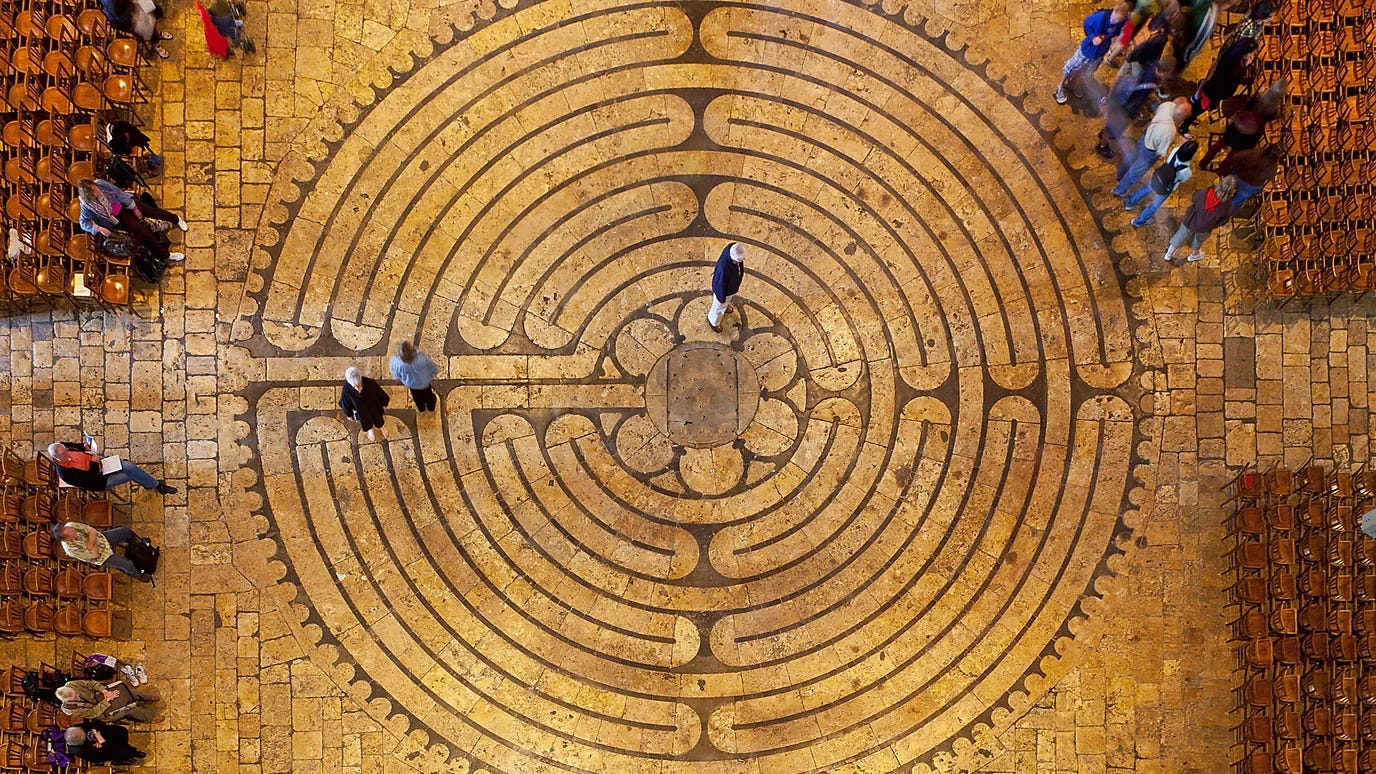
As a Christian spiritual practice, however, the labyrinth has its origins in the Middle Ages; the most famous one is inlaid at the Chartres Cathedral in France (above).
The idea is to take a winding path from the outside of a spiral into the center, and then slowly make your way back out. It is a sort of walking meditation intended to foster an ambling, non-linear communion with God. The labyrinth forces the walker to forget the precise trajectory of the path. Instead, she is invited to embrace the uncertainty of the journey.
The labyrinth, as it’s intended, is a portal to unknowing.
I remember, years ago, someone telling me that if I weren’t ready to learn a particular lesson, life would keep bringing me “back around the mountain” to try again. I’d keep encountering the same types of people, situations, and struggles until I’d learned whatever it was I needed to learn. I’ve found this to be true—the mountain has many paths, and I’ve often had to circle it dozens of times before mustering the bravery to walk the path life and God are leading me toward.
The thing is, though, that every time I circle back around, I know less than I did before. My certainty unspools itself until I approach that open, formless state of mind that John Keats calls negative capability: the ability to befriend “uncertainties, mysteries, doubts” without an “irritable reaching after fact and reason.”
The labyrinth is exceptionally good at nudging its walker toward mystery. So is life. And so is poetry.
My favorite Elizabeth Bishop poem is a villanelle titled “One Art.” As a form, the villanelle is a labyrinth of its own. Just when you think you’re getting somewhere new, the poem circles back on itself—we’ve been here before, and, spoiler alert, we’ll be here again.
This form can so easily go awry. All that repetition can smack of self-important sentimentalism at worst; at best, the repeating lines are simply not strong enough to carry the weight and tension of the poem’s progression.
But “One Art” is a villanelle master class. Every time a line is repeated, the entire poem shifts, kaleidoscopically, to reveal a new layer of meaning. At the start of the poem, the speaker seems fairly nonchalant about loss: keys, hours, places, names, no problem. We all lose things. Big deal, she seems to say.
But as the poem progresses, we detect a tinge of bitterness and real, immeasurable loss. The losses get farther, faster, and vaster, in the poem’s words. Better to learn the art of losing early in life, because all we ever do is lose things we love.
The real moment of clarity comes right at the end, with the words, “Even losing you.” This is the poem’s suckerpunch, when we realize all these losses weren’t just a trivial list of misplaced items. They were snowballing to the one great loss the speaker almost can’t name: the loss of love.
One Art
The art of losing isn’t hard to master;
so many things seem filled with the intent
to be lost that their loss is no disaster.
Lose something every day. Accept the fluster
of lost door keys, the hour badly spent.
The art of losing isn’t hard to master.
Then practice losing farther, losing faster:
places, and names, and where it was you meant
to travel. None of these will bring disaster.
I lost my mother’s watch. And look! my last, or
next-to-last, of three loved houses went.
The art of losing isn’t hard to master.
I lost two cities, lovely ones. And, vaster,
some realms I owned, two rivers, a continent.
I miss them, but it wasn’t a disaster.
—Even losing you (the joking voice, a gesture
I love) I shan’t have lied. It’s evident
the art of losing’s not too hard to master
though it may look like (Write it!) like disaster.
In a great villanelle, repetition can undo the reader’s assumptions. In the labyrinth, I think pilgrims find much the same. When we walk without a known destination, circling back on our own path, we start to release the things we thought we knew. Instead, we begin to encounter what actually is.
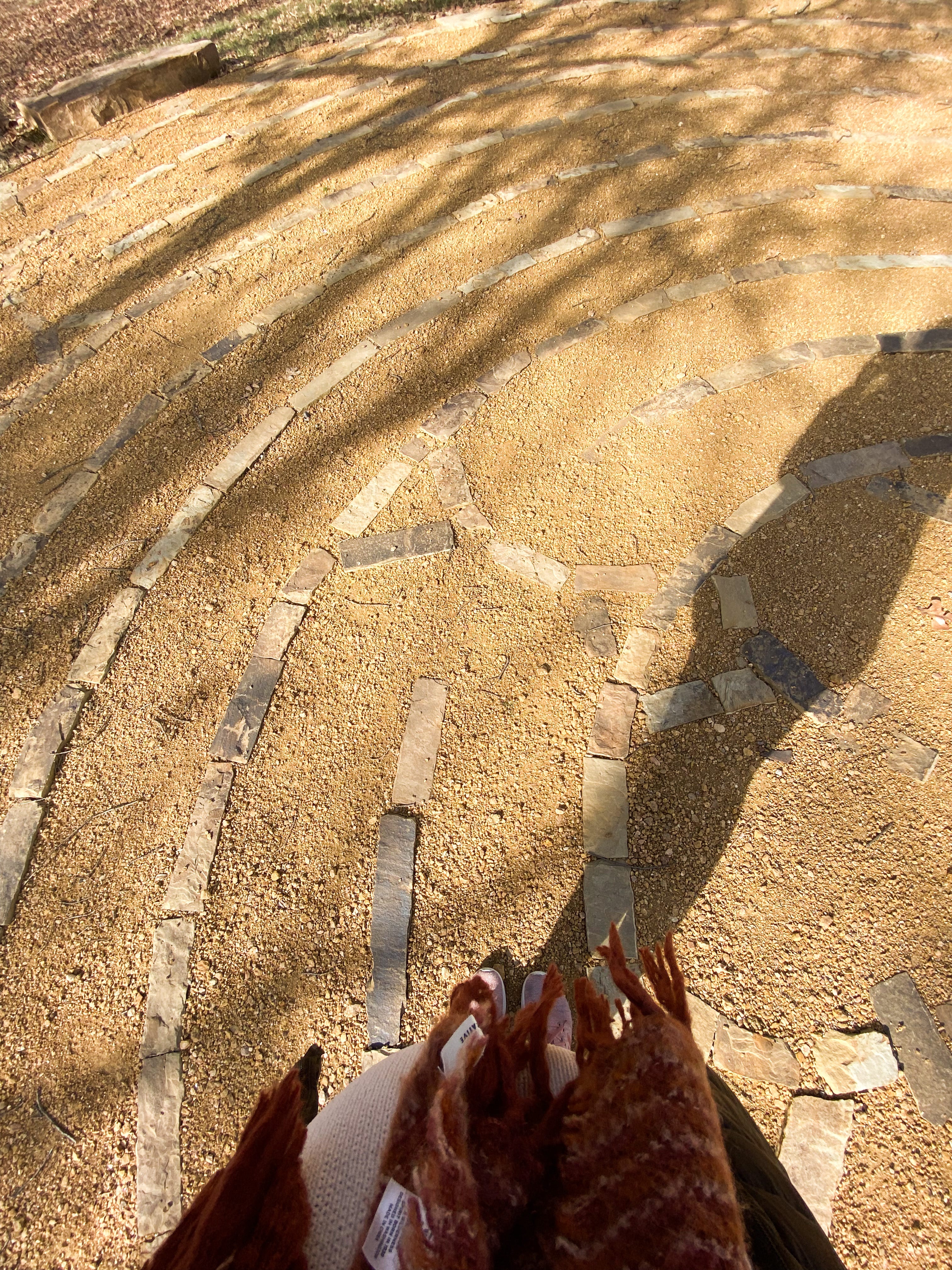
The entrance to the Prairie Labyrinth was flanked by walls of wheat. I entered and tried to slow my gait. Carved in winding rows among the wheat stalks was a path just wide enough to fit two people across. The sky was piercingly blue, with clouds scraped in lines like etchings on glass.
Because of the height of the wheat, I couldn’t see when or where the path would turn inward to the labyrinth’s center. I walked and walked and walked, swimming in yellow. I looked up at the sky and tried to enjoy being entirely alone with my thoughts. I could see no signs of life: no buildings, no people, no cars. I got antsy. The path was taking much longer than I expected, and my mind began to race. What if this was all an elaborate prank? What if there was no path, and I was wandering into the middle of the field, alone, no cell service and no one around? What if I was left walking for hours? My stomach was already starting to grumble, and I was fantasizing about the English muffins waiting for me back in my cabin.
At one point, I tried to part the wheat stalks to see if the center of the labyrinth was coming up anytime soon. Then I tried jumping up as high as I could, pregnant belly and all, to see over the heads of the wheat and determine where I was. No luck. All I could see was a small, endless existence of wheat and sky.
Eventually, the labyrinth dumped me out into an open circle with wheat on all sides. The moment held no overt spiritual secret or revelation. I looked around, exhaled with annoyance and relief, and turned to walk briskly out on the path I had just taken inward.
Looking for a portal to disappear into? Try these.
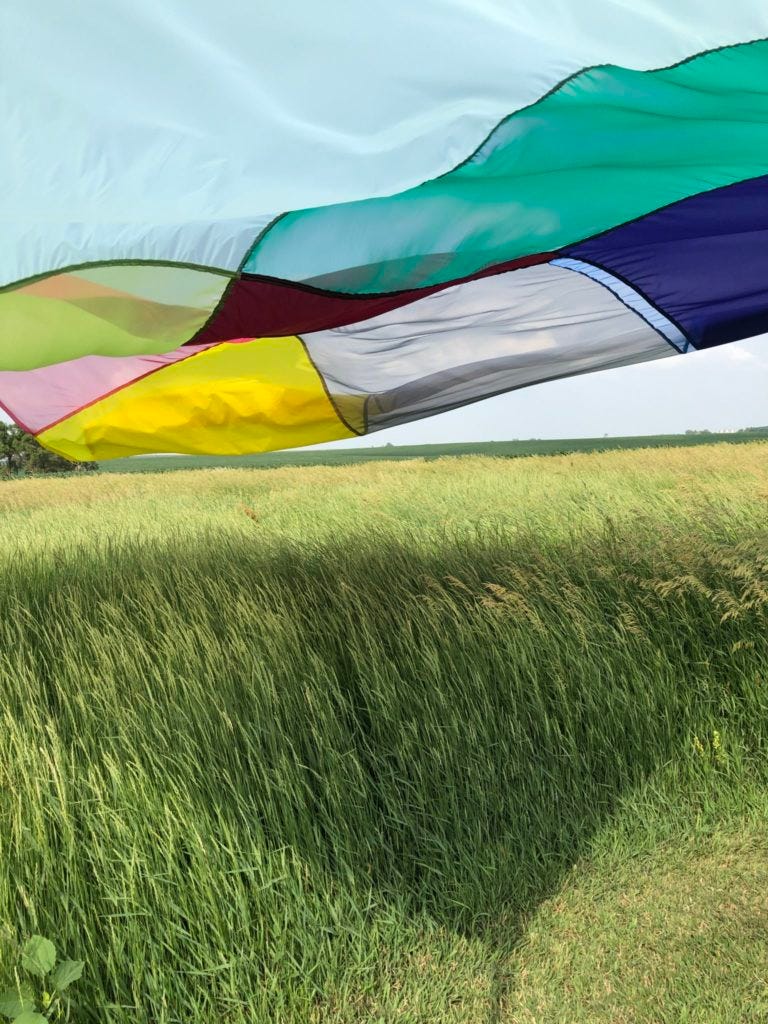
The art of Rachel Hayes is a portal unto itself. I went deep down the rabbit trail of her work recently, and I highly recommend it.
Learn more about labyrinths here.
Read about Elizabeth Bishop’s life and work.
My Neighbor Totoro is the autumnal nervous-system reset I didn’t know I needed. (And kid-friendly!)
Note: I never use AI to write, ideate, edit, or refine any part of my Substack newsletter.