

The Painting Darkens
On adoration and the receptive gaze

Weekend Exhale is a slice of creative margin and embodied attention. You’ll find bits of poetry, discussions of art, and embodied practices that keep me centered and living slowly in a culture that often pulls the other direction. If this work resonates with you, please consider becoming a subscriber. Or you can buy me a coffee. I’m so glad you’re here.

Autumn
by Jane Hirshfield
Again the wind
flakes gold-leaf from the trees
and the painting darkens—
as if a thousand penitents
kissed an icon
till it thinned
back to bare wood,
without diminishment.
I read this poem for the first time a few weeks ago, right here on Substack, when Amy Bornman shared it. I’m not new to Jane Hirshfield’s work (and have a few of her books here at home), but this one is new to me, and—whew.
I already knew Hirshfield to be the queen of a short, poignant poem. She needs so few words to construct an image and invoke an emotion. This one has lingered with me over the last few weeks, in part because the days are literally darkening as I speak. I find myself repeating—the painting darkens—for dramatic effect as I watch the leaves fall like yellow carpet across our yard.
This perspective makes the turning of the year feel intentional. Artistic, even. And when does the world more closely resemble an oil painting than in the heart of autumn, when light falls sidelong, casting everything into a chiaroscuro of falling leaves, surprising abundance, fading light?
I am taken by the idea of the world in autumn as icon, which darkens and wears with time and yet does not diminish. Hirshfield deftly constructs a parallel here: on the one hand, a worshipper venerates an icon. On the other, the speaker venerates the natural world. Perhaps they’re the same person. In both cases, the source of adoration is ever-present, dearly adored, and near enough to kiss.
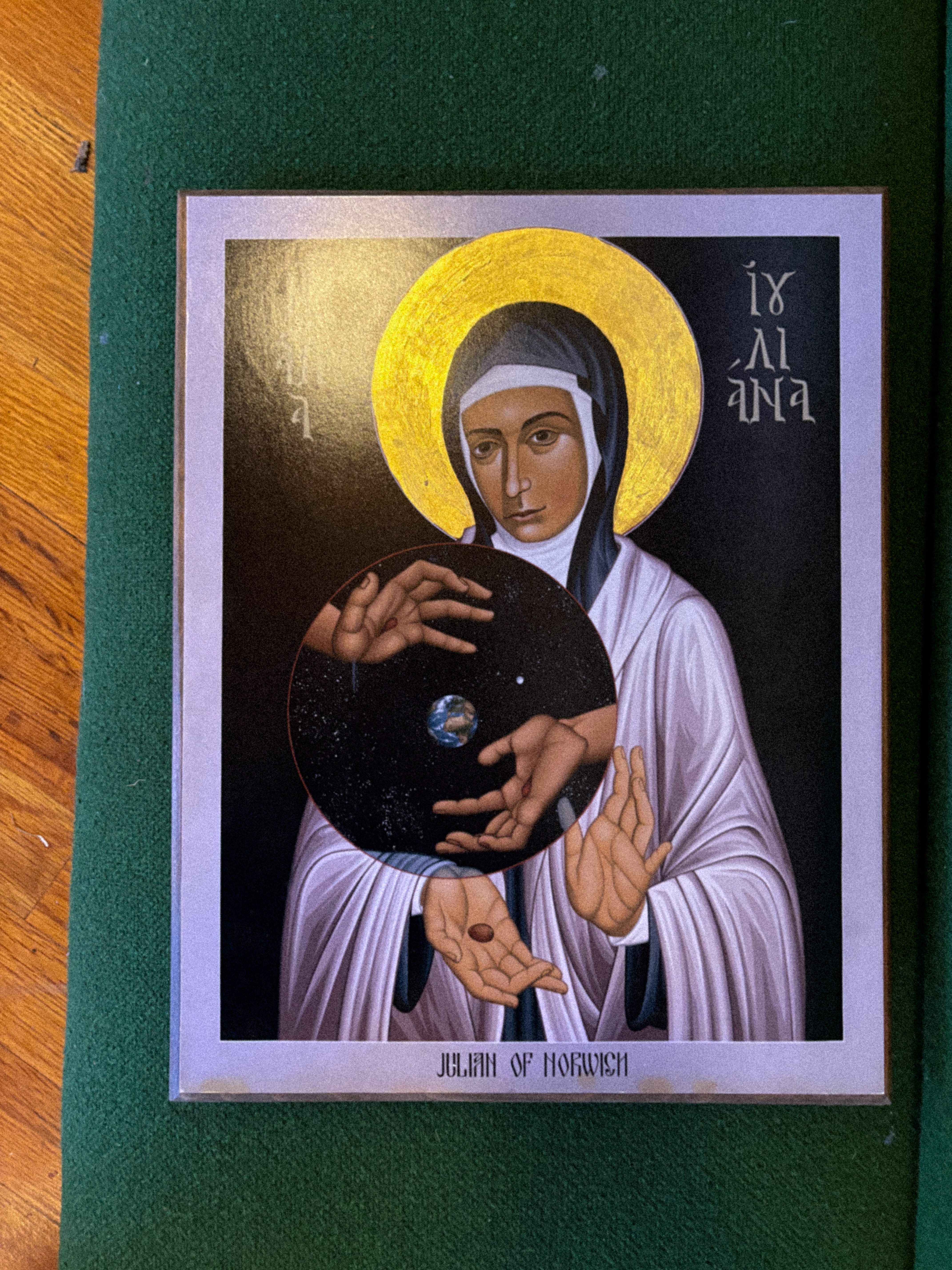
In my religious tradition, icon veneration isn’t exactly a thing. The sect of Christianity I grew up in took the “no graven image” commandment quite literally and, perhaps, to an unnecessary extreme. If you wanted an image of Christ to gaze at or dwell on, well, good luck.
We also held no discussion whatsoever of saints, or church fathers and mothers, or anyone beyond the Trinity and the figures whose words appear in our current iteration of scripture.
As fate would have it, I was invited to spend some time with an icon this past weekend at an Orthodox retreat center near OKC; I found it to be a surprisingly moving experience.
One of the many activities over the weekend was icon-gazing: We were invited to gaze at an icon of our choosing for 20 minutes. The selection was vast, ranging from images of Christ and Paul to Martin Luther King, Jr. and Fred Rogers. The facilitators asked us to keep our gaze soft and receptive—to receive rather than analyze or dissect.
I chose an image of Julian of Norwich, whose life and words have accompanied me for years now. I’ll be honest in saying that, for the first many minutes, I felt foolish. Nothing happened. I was staring at a picture of a woman who lived long ago. What was the point?
But as I softened my gaze and returned my mind to the subject in front of me, something shifted. I felt, indescribably, perceived and even beheld by Julian’s gaze. In her eyes, I saw the love of a mother who is undeniably kind yet who does not suffer fools. I felt her beckoning me up toward a truer, more mature way of being in the world. In that moment, she saw straight through my posturing, my vices, my excuses. She saw to my essence, and urged me to be true to it.
Of course, I can’t prove or verify that any of this happened, in the most literal sense. But I can say that I came away from the experience feeling stripped bare, seen, and lovingly challenged. And can any of that be such a bad thing?
I won’t lie that the kissing of her hands felt strange and unnatural to me. But I did do it. For icons that live in a public ecumenical setting or in the home of a religious devotee, I can imagine how the hands would wear, the gold leaf would flake, the painting would darken.
This is what always happens to the things we love and behold. They wear down, and yet, like The Velveteen Rabbit, they are rendered more real for having been seen, touched, loved.
I have a poem (recently published by Okie BookCast’s Behind the Rain Anthology) which I perceive to be in serendipitous conversation with Hirshfield’s. It speaks of our world’s diminishment and its renewal, its reality. It’s a poem whose events actually happened, exactly as I recount them here. When it did happen, I knew a poem was waiting—but I didn’t know how to access it. I think I held this idea in my mind for around a year before actually sitting down to write it.
I’m really proud of how it turned out, and I’m pleased to be able to share it here, with you:
Toy Bin Apocalypse
The puzzle my son received last Christmas
is made of small wood discs painted
like planets. We hold and study
them between us—Jupiter’s red bruise
of storm, Saturn’s silver rings, a single
moon, crater-pocked. Earth fits in his palm.
I point and tell him, this is where we live.
He doesn’t grasp how this toy images the green hills
of my childhood, mud path to the Harpeth River
where water moccasins nest. What business
does he have with continents? He cares only for our walk
to the park or the garden where he digs up arugula.
I find planets under dressers clung with dust
and lodged at the bottom of toy baskets,
amidst the debris of severed dinosaur tails.
No real surprise, then, when Earth went missing
for weeks. It could’ve been anywhere. When
it emerged from its distant orbit, it floated
in a pile of clean laundry, smelling of Tide.
My son had pocketed the world, and it spun
in soapy waters while we slept. We woke
to an orb washed clean of topography,
stripped back to blank birchwood, smooth
and blameless as a baby’s eye, opening.
Thank you for being here. Your attention, as always, is a gift.
A few more poems for your autumnal reading:
The Wild Iris by Louise Glück
blessing the boats by Lucille Clifton
I Loved You Before I Was Born by Li-Young Lee
Marcescence by Anna Laura Reeve
Hello, so happy to connect with you 🤍 I just subscribed to your content, and I hope you feel like subscribing to mine too 💌 xx
I loved your meditation on autumn and icons and I especially loved your poem, Toy Bin Apocalypse!