

For grief, a maple leaf
On dazzling gradually

Weekend Exhale is a slice of creative margin and embodied attention. You’ll find bits of poetry, discussions of art, and embodied practices that keep me centered and living slowly in a culture that often pulls the other direction. If this work resonates with you, please consider becoming a subscriber or buying me a coffee. I’m so glad you’re here.
When I first became a mother, I couldn’t write a single word about it.
I didn’t write much, period, but I stayed particularly far away from any sort of meaning-making about matrescence. It was too much, too bright, too close to even begin to make sense of. Tumbling as I was in the waves of becoming and unbecoming, I could hardly orient myself toward what was up and what was down—much less form any sort of cogent analysis of What It All Meant™️.
To do so would be like trying to sketch the Sagrada Familia with your nose pressed against one square inch of it. Or to describe the sensation of water to a life form who’d never experienced it. How to even begin?
Five and a half years in, that feeling has started to fade. I’m beginning to gain some perspective on motherhood’s myriad transmutations and my kids’ arrival into their selves. But I revisited my Notes app the other day and was thrust right back into that too-close feeling from early parenthood.
From November 2022 (when I had a 2.5-year-old and a 10-month-old):
“Motherhood: Can’t look at it straight on, too bright, it slips from my hands.”
I think parenthood is a great example of this consuming proximity, but any groundbreaking experience could feel similarly overwhelming in its enormity. A diagnosis, a move, a death, a perspective shift. These events that shake the foundations of reality cannot be processed or written about cleanly in real time. Often, all we can do is give ourselves over to the chaos and hope that some sort of clarity will arrive in hindsight.
One reason (among so many) I love poetry is its ability to plumb the depths of truths that defy tidy expression. Poems use a nifty little trick called metaphor (ever heard of it?) to arrive at an idea sidelong, by way of circumambulation.
Poetry knows its limits. A great poem knows it can’t really get to the heart of the matter, but can merely skirt around it—by way of image or feeling or inference—with the goal of drawing near to the unutterable reality that exists behind the veil of language.
The inimitable Emily Dickinson says it this way:
Tell all the truth but tell it slant —
Success in Circuit lies
Too bright for our infirm Delight
The Truth’s superb surprise
As Lightning to the Children eased
With explanation kind
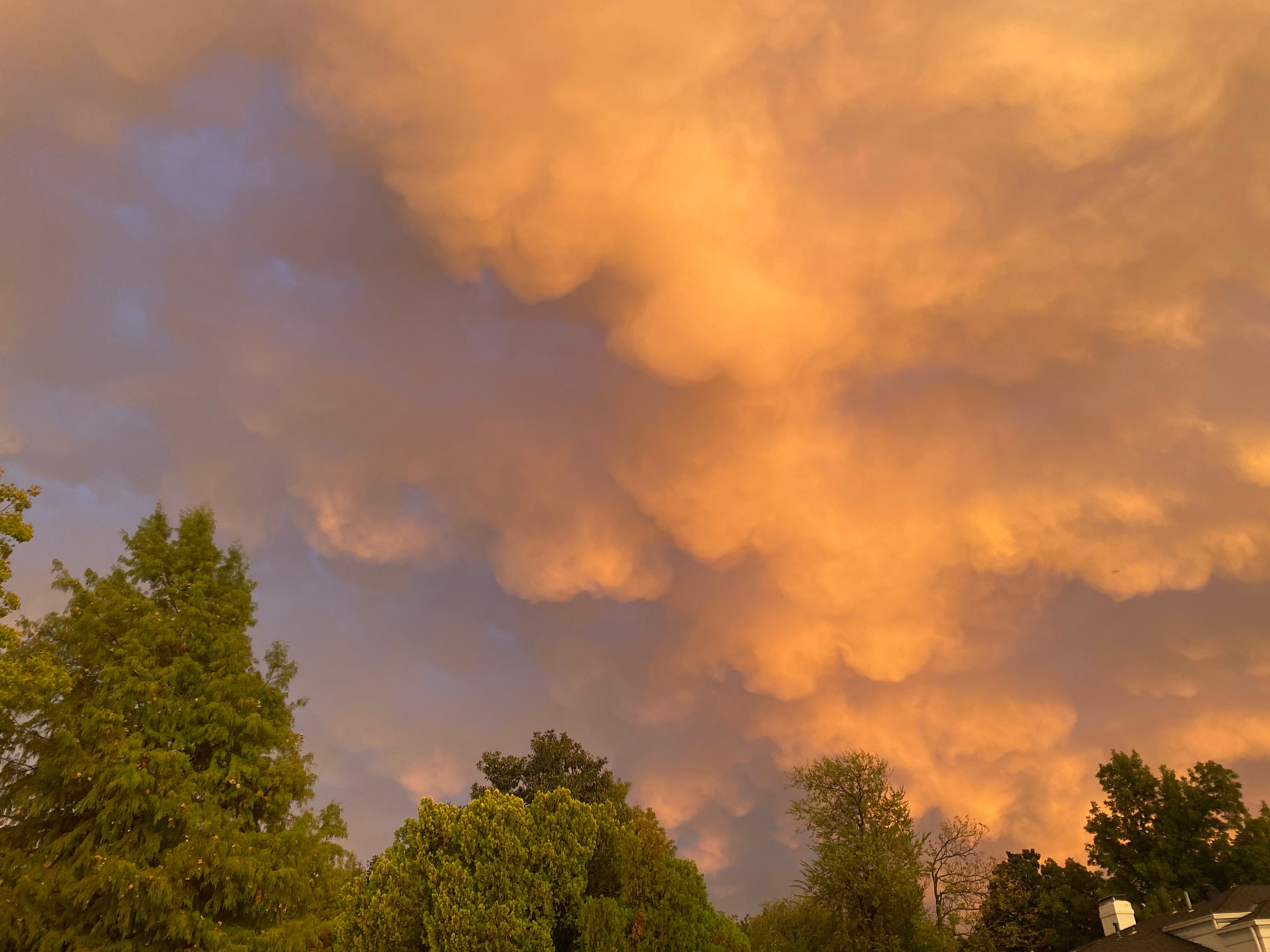
The Truth must dazzle gradually
Or every man be blind —
This is how matrescence and motherhood have felt for me—like lightning. Too dazzling, too superbly surprising (though superb is not the word I’d chiefly use to describe my experience, tbh). But our gal Emily D. suggests that any and all truth has that blinding quality to it. When we encounter what Father Richard Rohr calls the “really real,” it is shocking. Be it death or life, sickness or health, pregnancy or infertility, rage or delight, belonging or loneliness, the truest things can feel like too much.
Enter metaphor.
I could talk for literal days about metaphor. (Full disclosure: Along with the necessity of lemon in culinary endeavors and the superiority of warm-white Christmas lights, this would be my impromptu TED Talk topic.)
Metaphor is a sort of pre-logical magic, by which we can start to grasp at blinding truth by approaching it sidelong. Rather than a soliloquy on the nature of immortality, a single maple leaf falling can conjure the same ache. An image of a grandmother’s hands making pie can draw up feelings of familial love, legacy, or impermanence.
Poems hinge on image (by which I mean metaphor) to convey all their meaning. And I think this is precisely why there has been a collective return to poetry in recent years. We’ve reached the edge of our tolerance for grandstanding, political posturing, and the twisting of facts. We crave story and nuance more these days, because at least that way we have the luxury of arriving at our conclusions independently.
And while I do believe in some level of immutable truth which exists at the core of things, the shape that truth takes in a particular human life can vary widely. One person may associate a maple leaf with a very different emotion or memory than another. The goal, then, is not ultimately for the maple leaf to mean something. The goal is to see the maple leaf and to feel something. And for that something to feel, in some instinctual way, true.
Archibald MacLeish says much the same in his poem titled “Ars Poetica,” which means it’s a poem about the art of poetry.
For all the history of grief
An empty doorway and a maple leaf.
For love
The leaning grasses and two lights above the sea—
A poem should not mean
But be.
Sheesh, those last lines. I’d like to take them and extend them a bit.
Maybe my mothering isn’t about meaning at all. Maybe the rage and the joy I feel is its meaning. The endless bowls of dried mangos, the thousandth pull-up drawn over scrawny legs, the buckling and unbuckling of carseats, the chubby cheek kisses and raised voices. Maybe motherhood shouldn’t mean, but be. And maybe any slice of life is the same.
I can’t always claim to be a Good Mother™️, but I can claim to be a mother. And the moments of my motherhood are, I hope, forming some sort of composite experience which my sons and I will look back on with our unique mixes of emotions. Maybe they’ll remember my rage, or maybe they’ll remember my tenderness. But I hope that, whatever they remember, they perceive some inkling of truth, which is, of course, our love.
With that, I hope you feel some permission on this Saturday morning (or whenever you happen to read this), to let things be what they are. A maple leaf, a grief, a swelling of joy, a cup of coffee. This moment is poetry because this moment is what it is—one small, dazzling slice of what it means to be alive.
Loving Right Now
Speaking of sheer being alive-ness, this poem by the beloved late poet Andrea Gibson has me weeping. Click here if you want to hear Tig Notaro read part of it.
I had the unique and electric pleasure of seeing Jon Batiste live on his Big Money tour a few weeks ago. This song is on repeat at our house and I love everything about it.
Despite being an English major in college, I hadn’t read Frankenstein until just recently for book club. If that’s you too, now is the time!
I recently got the chance to pick some coveted Arkansas Black apples at an orchard with some dear, dear friends. And this week, I’ve been turning those apples into a maple and pecan compote (just call me Prue Leith). The recipe is similar to this, though I like the skins on. It’s perfection on oats, yogurt, ice cream, or just with a spoon.
I recently got some fun news in my local poetry community. You can read more here, and you can hear me read one of my poems in a poetry anthology by Okie Bookcast here. I’m the first entry, but keep listening for more fabulous Okie poets!
So true about how hard it is to write about some experiences, like motherhood, in the moment. Some art needs distance and experience and time before the metaphors start to catch up with you. And even then, I've mostly been successful writing about motherhood in ekphrastic poems, which give me a hook to get outside of myself. Seeing a picture of another mother gives me an image, a starting place, a bit of grit around which to start growing a pearl of a poem. Also, somehow it's gotten much easier as my kids got older.
Resonated with so much of this essay! Loved this bit: “To do so would be like trying to sketch the Sagrada Familia with your nose pressed against one square inch of it.”
In the early months of motherhood I kept thinking about the experience as a text that was held so close to my face that all the words blurred together. Too close to get a wrap any sort of meaning or narrative around it.